Tuesday, November 9, 2010

Half Moon Investigations by Eoin Colfer


This review is by Allegra, age 15.

General rating: 3 out of 4--a very good read.

This book is set in Ireland. Fletcher "Moon", also known as "Half Moon", is a 12-year-old private investigator who is hired by a girl from his school named April. She wants him to find a lost possesion. This leads him to a very large conspiracy.

1. Is it plausible? The 12-year-old private investigator isn't really plausible, but overall it was reasonably believable.

2. Is it thought provoking? Not really. You're usually too engrossed in the story to have any meaningful thoughts.

3. Is it engaging? It is very engaging.

4. Is it uplifting? Yes. There are some low parts and some high parts, but all in all it's pretty uplifting.

Language: none
Sex: none

My recommendation: Ages 10 and up would probably be ideal for this novel. I liked it because of the mystery that was involved. It was very interesting and had lots of twists and turns which kept me anxiously engaged in it. Also it was written by Eoin Colfer, who already has a long "rap sheet" of good books. (BTW, Isaiah, age 12, read it and said it was "okay".)

Artemis Fowl The Artic Incident by Eoin Colfer and...


Adapted by Eoin Colfer and Andrew Donkin
Art by Giovanni Rigano
Color by Paolo Lamanna

This review is by Isaiah, age 12.

This is the graphic novel of the book. Artemis receives an email telling him of his father's whereabouts. But! "The People", also known as fairies, think he is working with goblins. What will happen?

General Rating: 3 out of 4. It was fun to read.

1. Is it plausible? It is "unbelieveable" because fairies don't exist and neither do mythical monsters. But, since it is a fantasy, I guess it's a plausible one.

2. Is it thought provoking? No.

3. Is it engaging? Yes. It is a very good fictional book and is very engaging.

4. Is it uplifting? Yes, it is because in the end, they get the bad guys!

Language: none
Sex: none

My recommendation: It is a very good book for ages 10 and up. I like it because it's a mix between magic and warfare. The pictures were very cool. They had a lot of detail. A must-read for Eoin Colfer fans.

Wednesday, November 3, 2010

The Boy Who Dared by Susan Campbell Bartoletti


In Hitler's Germany during WWII, a boy who is member of Hitler's youth (as was required by law), and who is also a Mormon, illegally listens to the BBC radio, discovers that Hitler's regime is lying to Germans, distributes leaflets that tell the truth, and is imprisoned and executed as a traitor. This is his story, a piece of fiction based on a true story. It is written specifically for older children and young adults.

General rating:

1. Is it plausible? Yes. Although the author herself points out that this book is historical fiction, she wrote it after much research. The facts are true, but her portrayal of his thoughts are her conjection based on what she's learned about him.

2. Is thought provoking? Yes. Just like most of the WWII literature out there, this book inevitably invites the reader to compare his or her own convictions with that of this young man's. He was encouraged by friends and family members to think what he wanted certainly! But to speak only of what was acceptable. I think this is what most of us would choose to do--it seems logical and safe. But this boy took a great risk by showing, speaking and then acting upon his knowledge and his convictions. And he died because of it. Whenever I read books about persecution, racial cleansing, about genocides and holocausts, (another great one is "Left to Tell" by Immaculee Ilibagiza about the Rwandan holocaust) I find myself appalled and frightened at how quickly people are talked into spying on, reporting on, hating and even torturing and killing their neighbors and countrymen. Are we really followers to this degree? Are we really this bloodthirsty somewhere inside of ourselves? How can we so easily believe the lies of evil men and women? It's truly frightening and makes me determined to amplify that "voice" inside me, that voice that underscores truth and clarifies lies. How can so many people listen, swallow and then live such a horrendous lie like the one Hitler taught? Well, that question has been asked and answers have been given many times. Anyway, YES, this book is thought provoking.

3. Is it engaging? Yes.

4. Is it uplifting? Hm. Depends on your point of view. I found it disturbing--not uplifting. But it is uplifting to read about people who stood above the incorrect but popular dictates of their time. Helmuth Hubner was smart, peristent, brave and RIGHT. So that part's uplifting. I found the whole story horrifying, though, so it doesn't make the uplifting grade for me.

Language: none
Sex: none (although Helmuth is himself an illegitimate child and his mother's boyfriend does move in with the family)

My recommendation: If you like this kind of book, this one is a good one. I am so glad that Susan Campbell Bartoletii has told Helmuth's story. I don't like this kind of book at all... but I do think it's important to read these stories. I passionately dislike fiction that is about pain and suffering, but I honor the stories of REAL people who experienced extreme difficulties and chose to live honorably.

Tuesday, November 2, 2010

The Housekeeper and the Professor by Yoko Ogawa


A housekeeper and her son develop a relationship with her employer, a professor who, because of an accident nearly 20 years ago, only remembers things for 80 minutes at a time. The housekeeper must re-introduce herself to him every morning.

General rating: 3.8 out of 4 (I hesitantly question the plausibility because I enjoyed it so much.)

1. Is it plausible? Perhaps.

2. Is it thought provoking? Very much so. The professor is a mathematics genius and he uses math to relate to the world. There's a lot of math in this book, but it's more than just numbers and problems; in this book, the math problems symbolize life and its problems and beauties too. In fact, this is a very layered book, worthy of more than one reading.

3. Is it engaging? Yes. I sat down to read it and didn't get up until I finished.

4. Is it uplifting? Yes, it's uplifting and touching and educational. A very nice combination. There is so much that is suggested, left unsaid. It's a bittersweet and sentimental book about math and baseball and dear, kind people. A strange combination, perhaps. I closed the book with a very sweet feeling drifting right through me.

Language: none
Sex: none, although there are no intact families in this book, and several unwed mothers (and fatherless children) and references to one adulterous relationship. All benign, but there all the same.

My recommendation: A very sweet book about loyalty, love, service, strength... and, of course, math and baseball. I read it too fast to really do it justice (because it's due at the library today !! And I can't renew it cuz someone else has it on hold). It's a book that seems to ask for savoring, if you know what I mean. It's worth reading. I think those who like math and baseball would especially enjoy it. And I keep on thinking what a funny combination this book is: an old man, a young boy, a housekeeper, a sister-in-law, housekeeping, baseball, math, memories, injuries.... Unexpected and lovely.

Monday, November 1, 2010

Out to Canaan by Jan Karon


This book is a continuation of the Mitford series. Father Tim continues to plan for retirement, tries to find Dooley's scattered siblings, suffers through a highly contested mayoral race and unravels a little mystery.

General rating: 3.5 out of 4 (plausibility issues, as usual)

1. Is it plausible? Well... as I've mentioned before, it's "ideal plausible", if you get my meaning. I really don't think good things happen to good people all the time, although it's really sweet to read about that kind of thing.

2. Is it thought provoking? Yes, now and then.

3. Is it engaging. Very much.

4. Is it uplifting. YES.

Language: none
Sex: none

My recommendation: Another very sweet book. I liked it a lot. What else is there to say?

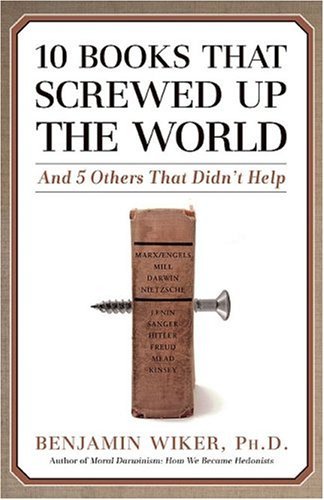
10 Books That Screwed Up the World by Benjamin Wiker, Ph.D.


This book is subtitled: "And 5 Others That Didn't Help". It is an indictment of a collection of books that have had really bad ideas that were widely believed and have become part of our reality. Writers of the earliest books often influenced the writers of the later books. Benjamin Wiker summarizes each book's arguments and refutes them and explains why they have been so harmful. The point of view is that of a conservative Christian.

General rating: 4 out of 4

1. Is it plausible? Yes. It is, of course, one man's point of view and is not meant to be a "balanced" treatment of any of the books included. A critic is quoted on the back of this book describing Wiker's summaries as "poison pen portraits" and it's a good description of his approach. He tears these arguments and their authors up--with the quotations and the research to back it all up.

2. Is it thought provoking? YES, YES and, uh, YES. I actually feel that I need to read it at least one more time just to get it all straight and clear in my mind. It was very interesting and there were many phrases and even paragraphs that I wanted to write down and read repeatedly. Here's one: "What is ideaology? We live in such an ideological age that it's hard for us to distinguish good thinking from bad. The crucial distinction is that ideaology is not philosophy. Philosophy is the love of wisdom, the love of what is real, whether we happen to like it or not. It is the desire for truth, and the continual humility to remold our desires to fit reality. Ideology comes at truth from the opposite direction, molding truth to what we happen to desire. Because it has no compunction about refashioning truth to fit our desires, it has no hestitation, in the hands of someone like [add your despised ideologist's name here], in refashioning reality according to our cravings. Pseudo-science is thus the handmaid to ideology. Politics is its hammer."
Whew! See what I mean? Yes! This book is nothing if not thought provoking.

3. Is it engaging? Surprisingly, yes. It took me a few days to get through this book because it was thought provoking and I needed "digesting" time, but it was engaging enough for me to read continually if only my brain were up to the extra work!

4. Is it uplifting? I thought so. It was freeing, for one thing. And it's always a rush of sorts when you read a book of ideas that dovetail with your own! I really enjoyed reading a book that made connections between some "classic" ideaologists and the "sacred" ideology in our own world today.

Language: none
Sex: there were notations of the sexual deviances of a few of the writers (e.g. Kinsey) that were a bit disturbing. But they weren't included for titillating purposes, but to illustrate (referring to my e.g. above) Kinsey's "reality" which, in turn, informed his "ideology" (I'm gonna have to start using that word in casual conversation--especially if I can manage to contrast it with philosophy in the same conversation!!).

My recommendation: A good read for anyone who considers him/herself a "thinker". I have a very tenuous grasp on many of the ideas written about in this book and it was good for me to know more. I also feel encouraged to make my own study of these authors so I can see for myself where my own disagreements lie. Wiker's prose was very accessible. The ideas are less accessible, but Wiker makes it as easy as possible to digest the things he is explaining. A very enjoyable book.

The Breadwinner by Deborah Ellis


This review is by Isaiah, age 12

General rating: 3.5 out of 4. It was not as interesting at the beginning.

This book is about a young Afghan girl who becomes the breadwinner when her father is taken by the Taliban.

1. Is it plausible? Yes, quite plausible.

2. Is it thought provoking? Yes, very thought provoking. I thought, "would it be possible for her to do all those things?" and it also made me wonder what happened next? It was a cliffhanger ending. It made me think, "wow, times were tough for women then!" (this book took place in 1996). I think things are easier now.

3. Was it engaging? Medium engaging. At first I wasn't that interested because it wasn't very interesting! But then it got interesting.

4. Was it uplifting? When I finished the book I felt that I was glad that we had free choice today and that we weren't forced to do things like the Afghans were back when this book took place in 1996. So, yes, it was very uplifting.

Language: no bad language except for the occasional "dumb" or "stupid"
Sex: none

My recommendation: I recommend this book for ages 8 and up. It was interesting and I learned a lot about the culture and some of the foods they ate. I also learned about how some of the families survived by having their children work to support them.