Tuesday, June 4, 2013

Last Ditch by Ngaio Marsh


     As you probably already know, Ngaio Marsh has been compared to Agatha Christie—some say she’s even better than the famous and prolific Christie. I love them both and find Marsh’s mysteries to have a little more “bite” than Christie’s, but quite a bit less “bite” than those by P.D. James. I really like all of these authors and am completely enjoying the Ngaio Marsh mysteries I’m reading lately.

     In this book we meet the son of our urbane and intelligent Inspector Alleyn, young Ricky Alleyn, who finds himself involved with a captivating lady, a repulsive artist, an oily landlord and a murdered horsewoman, all on an idyllic British Island off the coast of France where Ricky has gone to write. (How’s that for a one sentence summary!!)

     I liked Ricky immensely and, of course, who isn’t a little in love with Roderick Alleyn? The story was pleasantly convoluted and the supporting characters were interesting and, in some cases, satisfyingly offensive. I really liked the book.

Bad language: none
Sex: none

P.S. I always try to find pictures of the actual covers from the books I read. Sometimes they're harder to find than others. It was a little difficult to find a picture of this one (I'm too lazy to take my own photos), but here it is! This cover must have been, I imagine, from the original printing of the book--it looks so very 70s, doesn't it?

The Essential Haiku: Versions of Basho, Buson & Issa edited by Robert Hass


     I LOVE poetry! I can’t write it to save my life, but I love to read it. I especially love Haiku. They’re like little photographs, only deeper and fuller in that I feel I can smell and touch the atmosphere they create. 

     The Haiku form, according to this book, evolved in Japan from both Japanese and Chinese poetry. It started as something quite different from what we now know it as. This book contains histories of and haikus by three famous poets: Basho, Buson and Issa. Both Buson and Issa lived after and studied the works of Basho.

    I think I like Basho best, but I really enjoy the haikus of all three poets. This is my favorite book of poetry, although I love many others too. This collection is easy to read and full of information about the haiku, these three poets, the difficulties of translation, further reading, the prose of all three poets, and more. It’s an extremely evocative book, making medieval Japan come alive in the reader’s imagination. I feel steeped in beauty, freshness  and the world of nature every time I read this book. Highly recommended.

Bad language: Be aware that a few of these poems contain earthy language—haikus deal largely with nature, and nature defecates, urinates, copulates and is otherwise “natural”. Only 2 or 3 of these haikus have a little of this and there are limited reference to such things in some of the prose. I could wish that the translator had chosen more euphemistic words for some of these actions, but I trust he chose as he thought best. In any case, it doesn’t subtract from the transporting language of the vast majority of the prose and poetry in this book.
Sex: see the caution above

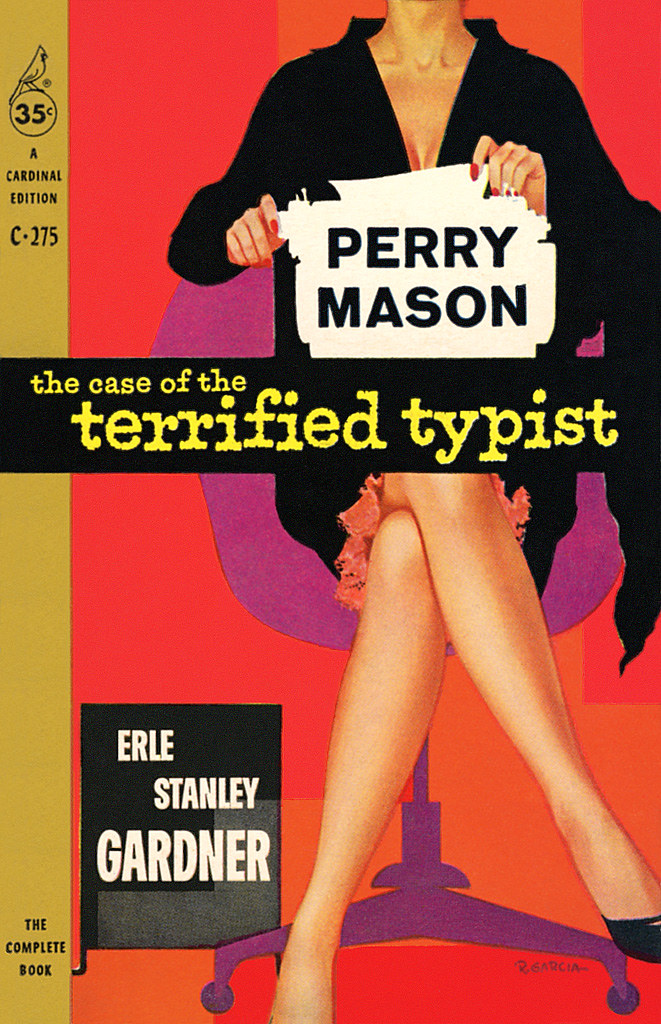
Perry Mason: The Case of the Terrified Typist by Erle Stanley Gardner


    Another Perry Mason case—and this one he actually LOSES (gasp!). But don’t worry—he prevails in the end and the good guys go free and the bad guys get what’s coming to them. And that’s not a spoiler, of course, since we all know that every Perry Mason book ends the same way—with everyone getting his or her just desserts and Perry Mason coming out smelling like a rose. 

     In this one, Perry discovers a fantastic typist, only to lose her a short time later in mysterious circumstances. Then he gets a client who he can’t seem to get through to—could the client be lying? And is he somehow connected to the mysterious typist?

     I like Perry Mason. I liked the TV show, I liked the TV movies and I am liking the books. But this one was a little slower than the others that I’ve read. There were quite a few legal explanations that I found a little dry. Quite a few. Is it because of who the book is dedicated to? I am a compulsive every-page reader, so I read the introduction and it was all about some admirable lawyer guy and I wondered if he was the reason that Erle Stanley Gardner (who is himself an attorney) filled this book with a bunch of “lawyer-ese”.  That stuff slowed me down a bit.

     However, the story was satisfying—and particularly involved, with quite a few twists and turns.  I enjoyed it very much.

Bad language: Nope
Sex: Nope

I Capture the Castle by Dodie Smith


     I guess this could be called a “coming of age” story, in that the main character, Cassandra Mortmain, grows in experience and wisdom over the course of the year that she records in her journals. These journals, which the reader is allowed to share, are filled with the voice of 17-year-old Cassandra, who starts her record as she and her family eke out a living in their romantic and ramshackle English castle, and then ends it in circumstances that have changed in every way.

     At one point in her journal, Cassandra expresses her preference for stories that are open-ended. A story that has a concrete end, she says, is like a wall, closing off the reader from further thought of the characters.  This is a point of view that, in theory, I think I disagree with. I really like all the i’s dotted and t’s crossed in a book and an unsatisfying ending is one of the worst things to be stuck with at the finish of a book, it seems to me. But this story is open-ended in a way that allows the reader to dream up the lovely, hopeful ending that seems hinted at, but is not yet fulfilled in Cassandra’s case. I think I did like that and I understand what Cassandra means about that open end. Hm.

     In any case, it was a lovely and engaging book. Did you know that Dodie Smith is also the author of “101 Dalmations”? I wonder what that book is really like (as opposed to the Disney movie). Perhaps I will read it next. I certainly enjoyed “I Capture the Castle and I highly recommend it.

Bad language: none
Sex: none

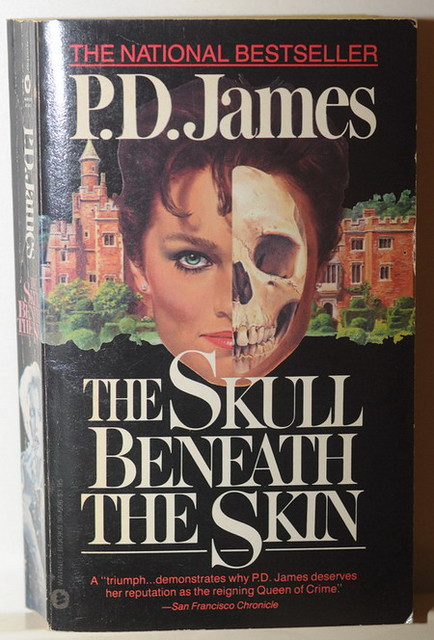
The Skull Beneath the Skin by P.D. James


     I really like P.D. James! This is her second Cordelia Grey mystery. Cordelia is a private investigator, so this book (unlike most of the P.D. James I've read) is not a police procedural. 

     Cordelia is hired to protect her client’s actress wife (Clarissa) on a private island where she (Clarissa) will star in a small play. Clarissa has been receiving threatening letters for months and Cordelia’s job is to shield the high-strung star from the letters—not the danger they threaten. Clarissa’s husband doesn’t believe Clarissa’s life is in any danger—just her serenity. Suspense, murder and danger follow.
     
     I always know what to expect from P.D. James. She is expert at picking apart her characters—their motivations, their feelings, their reactions. Her mysteries are as much psychology as they are action. I find I have to be in the mood for a P.D. James, but when I am, they are sublime.

Bad language: A few mild bad words, I think
Sex: Zero sex scenes. Clarissa and her friends are promiscuous, so infidelity and sensuality are referred to, but there are no descriptions—just the facts (and most of those are in the past).