Monday, January 16, 2012

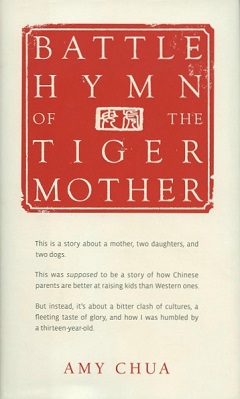
Battle Hymn of the Tiger Mother by Amy Chua


This book got a lot of press--excerpts from it were widely published and rebutted from many non-tiger moms. My sister-in-law, who has 6 kids and wants more, lent this to me. She LOVES the book and has even read it out loud to her kids. They like it too. wow.

The little blurb on the cover of this book says "This is a story about a mother, two daughters, and two dogs. This was supposed to be a story of how Chinese parents are better at raising kids than Western ones. But instead, it's about a bitter clash of cultures, a fleeting taste of glory, and how I was humbled by a 13-year-old."

I don't believe the part about the author being humbled :), but it sure feels like a story about how Chinese parents are better at raising kids than Western ones. I had to talk myself down from feeling defensive about my Western parenting more than once while I was reading.

As I read this book I found myself asking: how do I measure success in my family? What are my dreams for my children? Most parents wish their children to have it better, easier, safer, more. And how do we measure our success as parents? By what we can buy for our kids? Where we can take them? What experiences we can buy for them? What sports or instruments they play? Their grades? Their talents? Their performance? These are clearly the measurements Ms. Chua uses. She experiences some resistance from her younger (Westernized) daughter and struggles to re-frame (a little bit) her measurements of success. I wonder: can we say, as Westerners, that we don't use these measurements? I believe that in at least some part of our consciousness, most of us use these yardsticks to measure our success as parents. Many, if not most, of us pursue these ends for our children with our money and our efforts and the encouragement that we direct towards our kids.

The big question this book raised for me is: is it worth it? What IS success? I hope I don't measure it by all those things I listed at the beginning of that paragraph up there. Seems like there are more lasting things I'd like for my kids: good character, a strong spiritual foundation, loyalty, family solidarity, habits of charity, kindness. I tend to think competition has nothing to do with God, nothing to do with truly loving others. Hm. The tricky part of (theoretically) rejecting Amy Chua's measurements of success, though, is that success CAN build confidence and self-esteem. The ability to work hard (and those kids have got to work hard to earn those good grades, to become experts at their sport or their instrument, etc) is a gift we'd all like to give to our kids, if such a thing can be given. So the potential results of the push for successful kids are really good. But the potential pitfalls can rip a family apart and permanently damage the spirit of a kid also. So how far to push? What is success? Well, they're good questions, worth figuring out answers to.

It was a good book. Well worth reading, especially for parents.

The Samurai's Garden by Gail Tsukiyama


I read this for a book club. It was a WWII/leprosy/coming-of-age/racial understanding/forbidden love/unconditional love story. Yeah. A little too much going on maybe.

Stephen, a Chinese young man from Hong Kong, gets seriously ill and must leave college to spend some time recovering at the family beach house in Japan. His father, long estranged from the family (for business reasons, not so uncommon among the Chinese), lives in Kobe Japan. WWII is just breaking out, with the Japanese soldiers pressing through China, killing and plundering. Stephen finds tranquility, acceptance, purpose and love at the beach house. Meanwhile, back at home his mom and dad are having marriage troubles and the war is growing ever closer to his family and friends.

I actually thought the book was OK. It was sweet in a lot of ways.

But. Everything happened so fast that it all felt contrived to me. Deep relationships sprung up way too fast and on too little foundation. The 20 something young man (I think he had his 21st birthday at the beach house) had a voice that sounded more like a 12-year-old boy to me. And way, way, too much happened in one year to feel real. And I had some questions about the leprosy community that Stephen learns about. I thought such communities were receiving medical help by the start of World War two? That part seemed a bit anachronistic to me, but perhaps I'm just insufficiently educated about leprosy in Japan. The book made me think a little bit about The Pearl Diver by Jeff Talarigo, which was probably the most depressing book I've read in a very long time. It's about leprosy in Japan too.

I loved the snapshot of Japan that this book drew. I felt an attraction to life in a small Japanese village as Gail Tsukiyama painted it. I found the caretaker of the beach house, Matsu, believable and lovable.

It was a pleasant, if slightly unbelievable, book.

Sunday, January 1, 2012

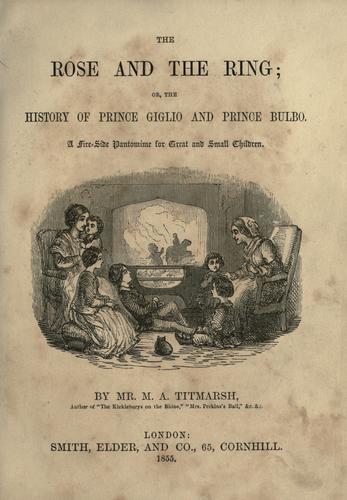
The Rose and the Ring by William Makepeace Thackeray


This was published by the author at Christmas 1854 and I found it referred to as a classic Christmas work in my annotated Dickens "Christmas Carol". I was confused when I read it because it has nothing to do with Christmas at all.

It is actually a pantomime play created by Thackeray and a friend for children. These pantomime plays were, apparently, a great Christmas tradition in England.

This one is silly and fun and a little bloodthirsty, which is, I suppose, a combination that generally does appeal to children. We get all weird about violence in TV and games today (and don't get me wrong, I am one of those who "gets all weird" to a degree and I don't have plans to change that), but it seems that children throughout the ages have always had a taste for violence. Why is that, I wonder?

Anyway, it was a fluffy little piece of nonsense that I won't return to but for one little jewel which I really liked. The fairy godmother in this story, who by this time has tired of the godmotherly gifts always demanded of her and has grown jaded in her belief that these magical gifts are good for her grandchildren, takes a backseat role. She blesses her godchildren in this story with a "little misfortune" which, she says, will be good for them. And by the end of the story you can see that she's right! Her godchildren, Giglio and Rosalba, do indeed have difficult lives, but those difficulties only make them stronger and more virtuous and even more deserving of the good fortune that lies in store for them.

The ring and the rose, by the way, make their wearers irresistibly attractive. Just so you know.

It was a quick read, an effervescent little story and--it was written by Thackeray (he wrote "Vanity Fair"), so you know there has to be a satirical element in there--about beauty and royalty--and if you are really interested, there are plenty of others who have offered their interpretations on that score. And there have been several TV/ film adaptations too! Interesting....

The Moonstone by Wilkie Collins


I believe this is considered to be the first mystery published in the English language. I found its title in some other book I was reading and looked it up to read for myself.

I really enjoyed it. It is so much in the style of all of the mysteries I've ever read I kept going back to the front of the book to check the publication date. This is the first one? Really? I guess I kept expecting it to be LESS of something, but what I should have been thinking is how excellently it set the pattern for all the many, many mysteries that have followed it.

There are many narrators to this story...a butler, an evangelist, a cousin, a lawyer, a doctor. All have their different styles and perspectives. I think my favorite was the evangelist because I loved to dislike her. The book abounds with witty lines and clever little ideas.

It is the story of a giant Indian gem, stolen during battle and willed in a vengeful spirit to our heiress, Rachel. Predictably enough, the jewel is stolen. But who by? And why are the Indian "Hindoos" still lurking nearby?

It's a surprisingly long book and I found the initial narrator to be the most witty but the least engaging (I don't know why)--I picked up and put down the book multiple times during that first part. But once I got past him--and I did thoroughly enjoy him--I had trouble leaving the book alone. I loved the conclusion. I had one of those "I KNEW it!" moments, when really I didn't know it at all. It was a lovely period piece that felt modern in so many ways. I really enjoyed it.

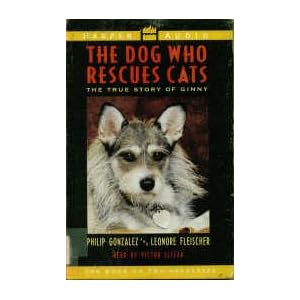
The Dog Who Rescues Cats by Philip Gonzales


This lightweight, uplifting book was the choice of one of my book clubs for the month of December--a sweet, easy, quick read.

The title pretty much says it all. It's a true story of one man's dog who changes his life and who touches other lives as well. The dog, Ginny, is especially sensitive to others who are handicapped--particularly to CATS who are handicapped. It's pretty amazing, actually.

While the writing was choppy and a little stilted, the story was fun to read and was uplifting as well. It re-framed for me the idea of the "cat lady" who has hundreds of cats in her house and in her neighborhood that she feeds, and others of her ilk. This "cat man" (and his dog) and his "cat people" friends opened my eyes to the reasons that many choose to become saviors of animals. It's easy from the outside to see this behavior as extreme--I've never been one to see my pets as people like me and I don't feel converted to that perspective either. But what I do feel grateful for is people like Philip Gonzales and his friends who give so much of their time, resources and heart to take care of God's creatures. I do believe that all creatures deserve their measure of joy and I was converted to Mr. Gonzales' personal crusade and the good of it.

It was a sweet book, a quick read and a warming story. Glad I read it.

The Mansion by Henry Van Dyke

This is another of Thomas S. Monson's (prophet and president of the LDS/Mormon church) Christmas favorites. I'd never read it before this year.

It's a story about a good man who rigorously builds his good name and reputation by choosing carefully which charitable contributions will be most prominently noticed and by ensuring public recognition for every good deed he does. What will his reward in heaven be? He finds out.

I actually found this story to be very thought provoking. It IS difficult to do good with no thought of thanks or recognition. Not that recognition or thanks is explicitly sought by most of us, I guess, just that part of the fun of giving is anticipating the joy of the recipient and, as this story points out, our Christian charity should not be motivated by thoughts of recognition or gratitude, but by true love of our fellowman and of God. An oft-stated message, to be sure, but no less true for all of that. It's an irony that these cliched messages that are so easy to gloss over or even reject as "trite" are so prominently quoted and re-quoted because they're TRUE. And we each figure that out from time to time as we are surprised by their actually applying to OUR lives! How about that!

Anyway, I really loved this little story. It was a quick read (and it's free online!) and I think I'll read it every year at Christmas, along with Luke 2 and Dickens' "Christmas Carol".

A Christmas Carol by Charles Dickens


I don't really need to review this one, do I? Although I suppose this one was a little different because it is the annotated version.

It has been years since I read The Christmas Carol--I've watched so many different film versions so often. What the films always leave out, though, is the Christianity throughout Dickens' tale--I had forgotten how religious he was.

I enjoyed reading all the explanatory notes this time too--I usually just skip over the parts that aren't familiar to me and it was good to slow down and read some background.

President Thomas S. Monson (prophet of the LDS/Mormon church) says this is one of his 3 Christmas favorites that he reads every year. I think I may make it a tradition for myself as well.