Sunday, May 8, 2011

The Memorial Hall Murder by Jane Langton


This book was written (and set) in the 70s. The story takes place at Harvard University. Visiting professor and retired policeman Homer Kelly unravels the mystery of the Memorial Hall bombing and the disappearance of a popular faculty member, musician and chorus leader Hamilton Dow.

This was one of those books where you know who the bad guy is just because you can't stand him! When I read mysteries I often look for the character that the author makes me hate. If there is a stand-out unlikeable guy, he will often end up being the murderer. If I can identify the murderer right away like this, then the story better be entertaining enough to make the book fun to read even though the mystery is a bit transparent. This book was interesting and I really liked the characters. But! It wasn't quite captivating enough to overcome the transparency of the mystery, although what created very readable tension in this book was the uncertain fate of the man trapped in the dark. Who is he? Will he survive? And I can't deny that it's very satisfying when the hated character turns out to be the bad guy and comes to a suitably bad ending.

There was a lot of detail about Cambridge the town and Harvard the university. I did get a good sense of the atmosphere surrounding Memorial Hall and the university in general. I didn't get a clear vision of it at all, but I did get a "sense" of it, if you know what I mean when I differentiate the two. I also felt very much in the 70's as I read the book. That was kind of cool. I enjoyed the illustrations--by the author herself! I also liked how alternate chapters told two different parts of the story--I was caught up in whether or not our trapped character would be rescued! Well, I knew he would be, but when?!

So, it was fun to read, but not at all gripping. I probably won't read more by this author, although I did really like our detective, Homer Kelly. He didn't seem to do a whole lot of detecting. The whole mystery was unraveled almost by accident! But he was very likeable and so was his wife. They aren't as well developed characters as some detectives are, but they are both charming and easy-going and comfortable. It was a cute book.

The Sherlockian by Graham Moore


This is both a historical novel and a mystery. Two stories are going on--they are told in alternating chapters. One is the story of a few months out of the life of Arthur Conan Doyle. Graham Moore takes the true outlines of Conan Doyle's life and extrapolates. We meet Bram Stoker and we get a taste of Oscar Wilde's personality. We meet some suffragettes and are introduced to a few philosophies on the subject. We get a glimpse into the mind of Arthur Conan Doyle as he "murders" his best known creation, Sherlock Holmes. We begin to see why he resurrects him, 8 years later.

The second story takes place in the modern day and is the mystery. The newest Sherlockian, Harold White, is caught up in the search for Arthur Conan Doyle's missing diary when the man who claims he has found it is murdered.

Both stories are mysteries, really, because both men are unraveling a crime.

I had a hard time getting into the book at first. I picked it up and put it down for days. About a third of the way in I was finally hooked. Part of the problem for me is that I didn't really like any of the characters. And I found Harold White to be a little unbelievable. That he was able to unravel a mystery that many Holmes experts had failed to up to that point seemed like a stretch. A big stretch.

It was an okay book. Definitely not one of my favorites. There is some crude and foul language--surprisingly used by the early 19th century characters, not the early 21st century ones.

Entertaining and interesting (once I got into it), but not great. That about covers it.

Wednesday, May 4, 2011

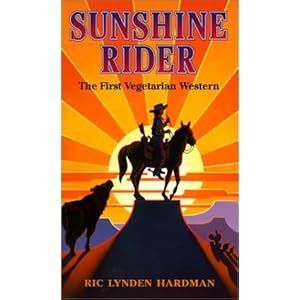
Sunshine Rider by Ric Lynden Hardman


I have never read a book like this one before. For one thing, it's a western, a genre I have not yet learned to appreciate. For another thing, I think it's totally unique. It's subtitled: "The First Vegetarian Western" and that is the reader's first clue that this is not your ordinary tale.

17-year-old Wylie Jackson, orphan son of a mild-mannered cotton broker (a tragedy he feels obliged to live down), joins his first cattle drive as an assistant cook. Before he leaves, his strong-minded friend Alice Beck assigns him to watch over her pet cattalo, Roselle, and make sure the animal gets safely to her aunt in Enid, Oaklahoma. Wylie Jackson eagerly leaves Odessa Texas and begins a series of VERY unexpected adventures that make a man of him.

This book is full of laugh-out-loud descriptions and one-liners. And recipes. And villains. And heroes. And Indians and cowboys and horses and doctors and wisdom and maturity. I'm having trouble describing it because it took me by surprise. It was charming and quirky. I loved it.

West with the Night by Beryl Markham


I really liked this book. I got my copy from the library, but it's one I would like to add to my collection. It's been labeled a classic because of its portrayal of early 20th century Africa--a time that has been romantically portrayed in many books and movies.

This is a memoir. Beryl Markham was born in England in 1902 and was taken by her father to East Africa in 1906. She learned horse breeding and training from him and struck out on her own doing this when she was just 17. Years later, when she was in her late twenties and early thirties, she learned to fly and carried mail, passengers and supplies in her small plane all over Africa. She ends her memoirs by writing about her flight in September 1936--solo across the Atlantic from east to west. She was the second person to do it and the first woman to do it. (Some accounts claim she was the first person to do it).

Not only was her life very interesting, but her writing is absolutely captivating. She's witty, self deprecating, wise and very entertaining. I loved her voice. Upon investigating her life further, I found she had left out MANY details of her life, some rather scandalous. She was apparently pretty wild. Our book club enjoyed discussing how so many of her life choices (that were not chronicled in the book) seem to belie her wisdom and warmth that come through so clearly in this book. It was truly a joy to read. I don't know if I'd have liked Beryl Markham in person, but I certainly do in her memoirs.

The Hidden Target by Helen MacInnes


I really really like Helen MacInnes. She writes political suspense novels and always includes a little romance as well. This book was published in 1980, but the story could just as easily have taken place now--with some nationalities and ideologies shifted just a bit. It's about terrorists and those that are used by them and those that work against them.

Nina, our female main character, is being used by a terrorist group and Robert, a friend from Nina's youth, chance-met on a street in Amsterdam, is working against terrorism. They meet accidentally and neither knows what the other is involved with. Yet.

Helen MacInnes joins Mary Stewart as one of my very favorite romantic suspense novelists. They both share the ability to completely engage without horrifying. And who can resist a little love interest along the way? I liked this book a lot.

Sunday, April 17, 2011

Locked Rooms by Laurie King


I so like this series!! Laurie King writes a continuation of the Sherlock Holmes series, with the wonderful addition of his partner (in every sense of the word), Mary Russell. I have really liked every book in this series (while at the same time really disliking Laurie King's other series starring the detective Kate Martinelli).

This book finds Mary Russell unraveling her past--the past that she's been running from for the past 15 or so years. She finally returns to San Francisco to deal with some pressing issues regarding her wealthy father's estate. What she finds there threatens to kill her, ends up totally shocking her and finally it frees her from demons she's been living with since her family died in an accident when she was just 14.

I loved reading about San Francisco in the time of the flappers--the jazz babies. I loved revisiting Laurie King's characters' memories of the great San Francisco earthquake. I, of course, love following the detective work of Sherlock Holmes and his irregulars. I also love getting to know these two characters, Holmes and Russell, a little bit more in each book.

This is a fat book, for more than a few hours of very good reading. I really enjoyed it.

The Overton Window by Glenn Beck


This was sort of a conspiracy book, sort of a wake-up America book, a patriotic book, a frightening book. It was very interesting. It essentially shows how a group of people can manipulate public opinion in order to further its own ends.

The "Overton Window" is a technique to force the public to accept events that normally would never be tolerated. Some examples of this technique in action: the modern trend to BUY bottled water--when our municipal water is often just as good. We have been convinced by some clever information spinning to pay for something that we can get for free. Also: our acceptance of the tight security at the airport. Something we would never, as a people, have tolerated (taking off our jackets and shoes, being patted down, being restricted as to what we can take with us, etc), we now tolerate without much complaint because of a major shift in perspective that happened when those airplanes rammed into the twin towers and the pentagon and changed our feelings forever. An even more serious pair of examples: Nazi Germany, the Rwandan massacre--both nurtured by misinformation and lies that the public was slowly fed until they finally totally accepted a twisted point of view and began persecuting and killing their neighbors. It is a technique that has been used forever and will continue to be used by those in power who inevitably become obsessed with their own visions. We are all vulnerable to this.

The book was fascinating and worth reading. Glenn Beck clearly states his agenda, which is essentially to wake the public into patriotic action, or at least to wake them to some of the things that are currently going on in our country. He includes a section at the back of the book with references for the reader to follow in order to investigate some of the true things that are in the story.

I'm glad I read this. But! It was, like so much of what Glenn Beck says, rather extreme. When I closed the book I felt that I hadn't liked it--it was frightening, it told of an America in which the "people" have no control. It presented a problem and offered no solutions beyond the general advice to wake up and look around at what's already happening. AND. The ending was not happy. And you know how addicted to happy endings I am. Having voiced those rather small objections, it was a book with a valuable idea to impart. Where do I go from here with this information? I'm not quite sure.